| Early Roman Calander | Julian Calander | Gregorian Calander |
| 1.Martius | Januarius | January |
| 2.Aprilis | Februarius | February |
| 3.Maius | Martius | March |
| 4.Junius | Aprilis | April |
| 5.Quintilis | Maius | May |
| 6.Sextilis | Junius | June |
| 7.September | Julius | July |
| 8.October | Augustus | August |
| 9.November | September | September |
| 10.December | October | October |
| 11.(none) | November | November |
| 12.(none) | December | December |
Showing posts with label Ancient History. Show all posts
Showing posts with label Ancient History. Show all posts
Wednesday, 12 March 2014
The Calendar through the years

Monday, 10 March 2014

Wednesday, 26 February 2014
Monday, 24 February 2014

Friday, 21 February 2014
Wednesday, 12 February 2014

Monday, 27 January 2014
Authorship of ancient texts
| Authors/composers or literary works | Approximate date original written or composed | Approximate date of earliest copy still in existence | Time span (from original to first copy) | Known numbers of first copy |
| Homers Iliad | 900 B.C. | 400 B.C. | 500 yrs | 643 |
| Aristotle | 350 B.C. | A.D. 1100 | 1,450 yrs | 49 |
| Plato | 400 B.C. | A.D. 900 | 1,300 yrs | 7 |
| Caeser | 50 B.C. | A.D. 900 | 950 yrs | 10 |
| Tacitus | A.D. 100 | A.D. 1100 | 1,000 yrs | 20 |
| New Testament | A.D. 40-100 | A.D. 125 | 85-25 yrs | over 24,000 |
Monday, 20 January 2014
Some Kings and Prophets of Israel
Israel
Kings and Prophets in their times
King Prophet
Jeroboam Ahijah
Nadab (None)
Baasha Jehu(Prophet)
Elah (None)
Zimri (None)
Omri (None)
Ahab Elijah and Micaiah
Ahaziah (None)
Jehoram (None)
Jehu(King) (None)
Tuesday, 12 November 2013

The Ten Plagues and their corresponding Egyptian Gods
The First Plague:
Nile turned to BloodGod:
Hapi - God of the NileWarnings:
- Fish will die
- River will stink
- People will hate to drink
The Second Plague:
Frogs come from the Nile
God:
Heket - Goddess of Fertility, Water, Renewal
Warnings:
- Frogs in all the food
- Frogs in peoples clothes
- No one can make them go away
The Third Plague:
Lice from the EarthGod:
Geb - God of EarthWarnings:
- The Lice will be everywhere
The Fourth Plague:
Swarms of Flies
God:
Khepri - God of creation, movement of the sun, birth
Warnings:
- Flies destroy the Egyptians things
- Flies cause the Egyptians discomfort
The Fifth Plague:
Death of LivestockGod:
Hathor - Goddess of love and protectionWarnings:
- No reproduction of the Egyptians meat source
The Sixth Plague:
Boils
God:
Isis - Goddess of medicine and peace
Warnings:
- The Egyptians will suffer
- The Egyptians will be 'Unclean'
The Seventh Plague:
Fire from the skyGod:
Nut - Goddess of the skyWarnings:
- Will destroy the flax and barley which are the main food source and are used to make clothes
The Eighth Plague:
Locusts from the sky
God:
Seth - God of storms and disorder
Warnings:
- All the crops left will be destroyed
The Ninth Plague:
Three days of DarknessGod:
Ra - The God of the sunWarnings:
- No one can see except the Israelites
- The Darkness in Egypt was so complete that you could feel it
The Tenth Plague:
Death of the first born
God:
Pharaoh - The Ultimate Power of Egypt
Warnings:
- All of the First Borns of Egypt will die unless they put lambs blood above their doors
Tuesday, 22 October 2013

Wednesday, 2 October 2013
The Tombs of Ur
Sir C. Leonard Woolley
and his discovery of
The Royal Tombs of Ur
Report By: Hannah Marriott

C. Leonard Woolley, an archaeologist, from 1922 to 1934 excavated the site of the ancient Sumerian city of Ur. He made many great discoveries about the people who lived there, mainly from the burials. Leonard found 1800 tombs. 16 of these tombs had more valuable objects than in the other 1784 tombs. These 16 tombs, Leonard called 'Royal Tombs'.
 |
| Tomb Plan |
Sir Charles Leonard Woolley was born the 17 of April 1880 in London, England
and died the 20 of February 1960 at the age of 79.
Ur
The City of Ur, hometown of Abraham, is located in Sumer (southern Mesopotamia), near the Rivers of Tigris and Euphrates on the Persian Gulf. Ur, also known as Tell al-Muqayyar (a tell is a hill made of crumbling buildings with new building made on top), was one of twenty such city-states flourishing in the valley between the Two Rivers between 2,900 and 2,350 B.C. It was also was an important Sumerian city state between 2025-1738 BC. The remains of the city are now in Iraq, near the city of Nasiriyah and south of Baghdad. The City is mainly made out of mud-brick structures built on top of each other. Ur covers about 60 acres, and is surrounded by a city wall.


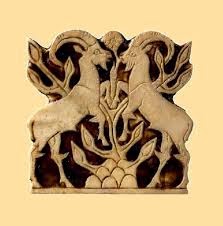
 Items in the Tombs of Ur


I owe my thanks to:
Click on the Web Pages above to explore the mysteries of the ancient civilization of the Sumerians
Subscribe to:
Posts (Atom)